
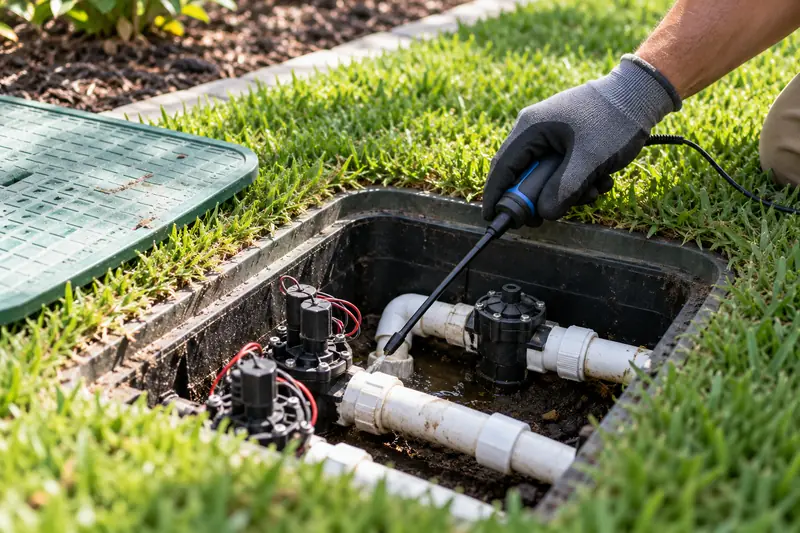
Find which part of the irrigation system is involved
An irrigation assessment should first distinguish the supply feeding the valves from the downstream piping that waters individual zones. Depending on the design, the supply may remain pressurized between cycles, while zone piping receives water only when its valve opens.
That distinction changes the search. Water appearing only during one station's run suggests a different test sequence from unexplained flow while every station is off. The provider should establish the actual valve and master-valve arrangement before drawing conclusions.
Define whether the concern is at the controller, an accessible valve, a sprinkler head, or a buried branch. Confirm whether the proposed visit covers detection only, an accessible component repair, or further investigation before any buried-pipe access. These are different scopes and should be identified before work starts.
Symptoms worth recording by zone
EPA WaterSense recommends inspecting irrigation zone by zone and checking visible connections, valve boxes and pooling between cycles. Record the station number and whether the controller was watering when you noticed the symptom.
- One sprinkler zone has noticeably reduced reach or incomplete pop-up.
- A wet area persists when surrounding ground has dried.
- Water appears in a valve box or beside an exposed fitting.
- A head keeps dribbling long after the watering cycle ends.
- An unexpected high-flow alert repeats on the same station.
- A water bill changes without a corresponding change in watering or occupancy.
Common causes and problems that resemble leaks
Broken heads, damaged joints and valves that do not close fully can waste water. EPA also identifies incorrect programming and misdirected sprinklers as separate sources of waste. A long watering schedule can produce saturation without a buried pipe failure.
Rain Bird describes low-head drainage: water left in zone piping flows toward a lower sprinkler after shutoff. Temporary drainage differs from a valve continuing to pass new water. A suitable check valve can address low-head drainage, but that does not establish that a leaking zone valve has been repaired.
Weak pop-up can involve water loss or worn sprinkler seals, according to Hunter's troubleshooting guidance. The provider should also check system operation and available pressure. Ask which observations support a leak before approving excavation based only on weak coverage.
How zone-by-zone diagnosis can work
Begin with the controller schedule, zone map and known changes. The provider can confirm station labels, locate accessible valves and observe a baseline when irrigation is off. Other water uses must be accounted for before interpreting movement at a shared property meter.
Next, operate selected zones under an agreed test plan. Compare head performance, visible escape points and any available flow information. Brief, supervised observations may be enough to identify a broken head; a suspected buried line can require a narrower investigation.
Isolation can help determine whether unexplained flow belongs to irrigation or another branch, provided the actual valves can isolate those systems. Ask who is authorized to operate valves and whether irrigation shares a supply with other equipment.
If the evidence points below ground, the provider can explain which locating method suits the pipe and conditions. Record the suspected area and confidence before digging. Surface wetness identifies an affected area, not necessarily the exact buried break.
Comparing irrigation detection methods
Available techniques depend on the installation. Sewerin describes acoustic methods for pressurized water networks, while Hunter documents controller-based flow monitoring. Ask how the proposed method fits the affected irrigation branch, controller, and available access, and what finding would justify further investigation.
| Method | Best use | Limit |
|---|---|---|
| Supervised zone observation | Find broken heads, exposed escapes and irregular performance. | Hidden leaks may not create an immediate visible symptom. |
| Meter or branch isolation checks | Narrow unexplained use to irrigation or an isolatable branch. | Shared uses and valves that do not isolate properly complicate results. |
| Zone flow comparison | Identify a station whose demand differs from its expected operation. | Nozzle changes, pressure and controller settings can affect the baseline. |
| Pressure measurements | Compare operating conditions at appropriate accessible points. | Low pressure alone does not prove a buried pipe leak. |
| Acoustic listening | Investigate escaping water where a usable leak sound is present. | Suitability and accuracy depend on the pipe, access and site conditions. |
| Authorized targeted exposure | Visually confirm a suspected buried connection or pipe defect. | Requires excavation planning and a separate restoration agreement. |
Prepare the controller, outdoor access and records
Photograph controller settings before making changes. Gather station names, watering days, seasonal adjustments and any flow-alert history. If you have a planting plan, mark recent planting, fence work or other activity near buried piping.
Arrange access to the controller and accessible valve boxes. Keep the original labels, and identify locked areas, shared landscapes or zones managed by someone else. Tell the provider if the system uses reclaimed water or has a separate irrigation meter.
Do not open pressurized fittings, bypass backflow equipment or excavate around unknown services. Discuss underground-service locating and private irrigation-line identification before digging. A provider should explain how the proposed work protects adjacent planting and outdoor features and who handles reinstatement.
- Note how long a wet area remains after irrigation stops.
- Provide utility usage records covering comparable watering periods.
- Ask whether to pause the affected schedule while awaiting assessment.
Cost factors and proposal comparisons
The number of zones, missing labels, buried valves and incomplete plans can expand the investigation. Pipe beneath paving requires different access planning from an exposed fitting. Intermittent faults, shared meters and unavailable isolation valves may require additional work.
Request terms that distinguish controller checks, zone testing, acoustic investigation, excavation and repair. Clarify whether an initial visit includes a marked suspected location, photographs and a written explanation. Agree on authorization before extending the search.
Separate pipe work from turf, planting, irrigation adjustment and hardscape restoration. Ask whether the repaired zone will be checked under normal operation and whether controller settings will be documented afterward. Compare equivalent scopes rather than assuming that every irrigation proposal includes all reinstatement.
Limits, repair options and checking performance afterward
Detection can identify a defective head, suspect valve or likely buried section, but some sites require exposure for confirmation. A quiet listening result or normal short test does not exclude every small or intermittent leak. Ask what was observed and which zones remain untested.
The repair should match the finding. Replacing a damaged head, correcting a valve fault and repairing buried piping are different tasks. Reducing runtime may limit waste temporarily but does not close a broken pipe. Conversely, repairing a pipe does not correct an unnecessarily long watering schedule.
After repair, ask for checks of the affected zone's flow, shutoff and coverage. Hunter warns that flow-monitoring setup and pressure fluctuations can cause misleading alerts. Confirm whether the existing baseline needs review after nozzle or system changes, and keep that work distinct from the original leak search.
Discuss the affected irrigation zone
Identify the property locality, affected station and whether water loss continues between cycles. Call Hydriva with the controller information, operating pattern, and visible outdoor symptoms to discuss the irrigation inspection. Include any shared supply, locked valve enclosure, or earlier repair that could affect access and testing.
Where several people maintain the grounds, gather their recent changes to the controller and valves before the visit. Label the controller station and the physical area separately; a handwritten station name may no longer describe the installed layout. Ask the provider to verify that relationship before using it to identify a suspected branch. Include any known shared supply or association-maintained area in the access discussion.
After an authorized repair, keep a record of the addressed component and the operating conditions used for verification. If a different area remains wet, report it separately rather than assuming the first repair should explain every outdoor symptom. Confirm who will restore the agreed watering schedule and who should be contacted if an unexpected discharge returns. Do not leave an unfamiliar setting changed without the responsible owner's knowledge, and do not interpret restored sprinkler operation as a condition report for every buried irrigation line.
Inspection notes
Irrigation & Sprinkler Leak Detection questions
What affects the cost of irrigation-leak detection?
The number of affected stations, controller information, valve access, unknown buried routes, and shared supplies can change the work. Clarify whether testing, component repair, excavation, and planting restoration are separate. Call with the station and operating pattern to discuss the required inspection scope.
What location information helps arrange a sprinkler inspection?
Give the city, state, address, affected area, and the person who controls the irrigation. Mention a separate meter, reclaimed-water system, association-managed grounds, or locked enclosures if relevant. Call with that information to confirm availability and discuss zone-specific testing before anyone alters the controller or piping.
Why does a sprinkler keep leaking after the controller turns off?
It may be draining water already in the piping, or the zone valve may still be admitting water. The pattern and duration help a provider distinguish those possibilities. Rain Bird explains that low-head drainage occurs at lower emitters after shutoff. Ask for the cause to be confirmed before replacing the head or valve.
Does turning off the controller stop every irrigation leak?
It stops scheduled commands, but it does not necessarily remove pressure from the irrigation supply or stop a mechanically leaking valve. The result depends on the installed system. Ask the provider which approved shutoff isolates irrigation and who should operate it. Avoid forcing an unfamiliar valve or disabling shared equipment.
Can low sprinkler pressure prove there is a buried leak?
No. Weak performance is a reason to investigate, not a location finding. The provider should evaluate the zone's actual operating conditions, accessible components and water demand. Ask whether flow or isolation evidence supports a hidden loss and what additional test would narrow it. That explanation matters before authorizing trenching.
Will a smart controller find the exact break?
A compatible flow-monitoring system can flag an abnormal station or flow condition, but the alert generally needs investigation to locate the defect. Hunter's guidance explains that settings, startup conditions and supply-pressure changes affect interpretation. Provide the alert history and recent system changes; do not assume the controller has identified a precise excavation point.
What should I do if irrigation appears to wet the foundation?
Document which zone runs before the dampness appears and ask about pausing that zone pending assessment. An irrigation provider can examine spray direction, scheduling and possible losses, while a building-moisture investigation may be needed to establish the entry pathway. Repairing irrigation and evaluating foundation moisture are related but separate scopes.
Related inspection guides
Compare other leak detection services from Hydriva, or find your city and state in the location directory.
Sources and further reading
- EPA WaterSense: Sprinkler Spruce-Up inspection guidance
- EPA WaterSense: Home maintenance and meter checks
- Rain Bird: Low-head drainage and check valves
- Rain Bird: Valve troubleshooting guide
- Hunter Industries: Spray-body and nozzle troubleshooting
- Hunter Industries: Flow-monitoring system considerations
- Sewerin: Acoustic water leak investigation
- PNNL: Exterior moisture review including nearby sprinklers