Brighton neighborhoods and local areas
- Brighton CrossingBrighton Crossing appears among the city's development groupings and in its planning documents.
- Bromley ParkThe city lists Bromley Park among Brighton's development groupings.
- Platte River RanchThe city lists Platte River Ranch among Brighton's development groupings.
These names describe places; they do not establish utility responsibility, pipe condition, or appointment availability. Follow the local references in the city and state directory for the type of area and supporting source.
Start with the Brighton account, not just the bill total
The City of Brighton publishes separate information for water, wastewater, and storm drainage services. Establish which account and charge changed. A higher total does not by itself show that more drinking water passed through your meter. Keep the complete bill, including the reading dates and charge descriptions, rather than sending only the amount due.
Make a short comparison sheet with the current consumption, the previous comparable period, the number of days covered, and any occupancy change. Note a visiting household, newly occupied unit, pool filling, landscaping work, or equipment that ran longer than usual. These are questions to investigate, not explanations to assume. A useful discussion distinguishes a billing question from confirmed unexplained water use.
Use the supplier printed on the bill. A Brighton mailing address or nearby development name is not sufficient evidence that the property has a particular utility account or that Hydriva has an available provider for that system.
Why the winter timeline belongs in your inspection records
Brighton's published residential billing guidance uses average water consumption in December, January, and February as the basis for sewer usage charges. The city asks customers with unusual winter use, including a leak, to contact Utility Customer Service about evaluating that calculation. This is a reason to preserve dates, not a promise of an adjustment.
Record when the abnormal use started, when someone investigated it, and when any repair or operating change occurred. Save the report and repair invoice separately. If the source is still uncertain, say so. An unexplained period of use, a confirmed leaking fixture, and a repaired buried line are different findings and should not be described interchangeably.
Ask the utility what documents it currently requires and which account the inquiry concerns. The provider's report should describe the tested system and findings; the utility makes its own billing decisions. Hydriva does not approve credits, determine sewer charges, or guarantee how an account review will end.
Use a recorded pattern to choose the first inspection
Brighton's conservation guidance recommends looking for unexpected use and comparing meter or submeter readings. EPA WaterSense also describes checking a safely accessible meter during a period without ordinary use. These observations can support a water-loss inquiry, but a reading does not identify the leak location or prove that a buried pipe is responsible.
Write down the times as well as the numbers. Record whether irrigation, a washing machine, a water-treatment cycle, or another known demand was operating. If you cannot verify that all ordinary use stopped, label the observation accordingly. A provider can make a better decision from an honest incomplete record than from an unsupported claim that everything was off.
Connect the usage record with the physical symptom. Note whether a damp area appears continuously, after a fixture drains, after irrigation, or after precipitation. Do not enter unsafe spaces or disturb concealed piping to gather evidence. The purpose of preparation is to narrow the question while leaving testing and interpretation to the appropriate provider.
Keep basement moisture separate from supply-line loss
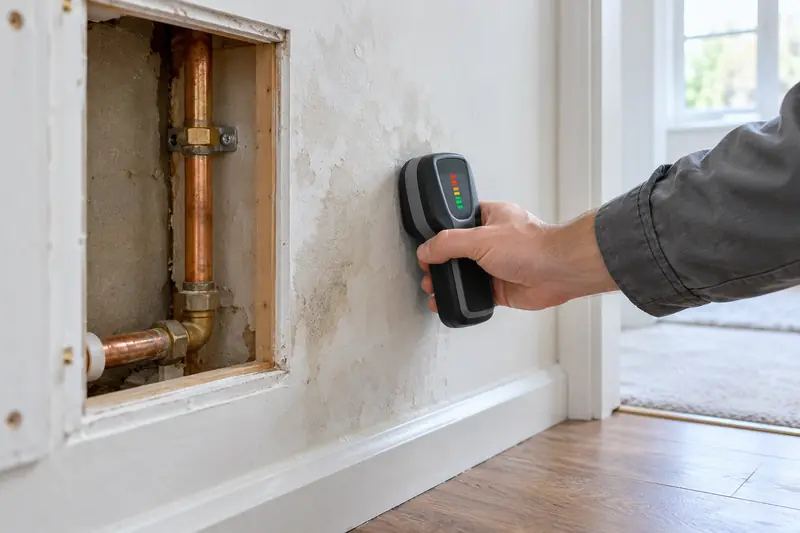
A wet basement deserves attention even when a water account looks normal. Begin by describing the affected wall, floor junction, ceiling, or equipment area and the timing of the moisture. Supply plumbing, a drain, exterior water entry, and condensation are different possibilities; choosing a supply-line test solely because the surface is wet may leave the actual concern unanswered.
Ask what the first visit will evaluate and what it will exclude. A plumber investigating a concealed pressurized line may not be undertaking a full building-envelope or drainage assessment. Conversely, an exterior drainage proposal should explain the evidence for that scope rather than treating a location name or wet surface as proof of the cause.
If water is near electrical equipment, keep away and obtain appropriate urgent help. Do not step into standing water to photograph a panel, operate an appliance, or reach a shutoff. Record safe observations from outside the affected area, and explain that access is restricted when arranging assistance.
Use neighborhood and district names to plan access
Brighton's official metropolitan-district information names development groupings including Brighton Crossing, Bromley Park, and Platte River Ranch. These references help describe the location, but a district, association, utility account, and individual property are not interchangeable. Do not infer responsibility for a private pipe from the name of the development.
Provide the exact street address and any building, unit, or access identifier. If landscaping or a shared service line is involved, ask the owner or manager who can authorize testing. A person able to open a gate may not have authority to approve excavation, interrupt water use, or contract for repair on shared property.
Keep any relevant association or district contact details with the inspection information. Use them to resolve access and ownership questions when necessary, rather than assuming that the district performs private leak investigations. The neighborhood references on this page are not Hydriva office locations, completed-project claims, or guarantees of appointment availability.
Agree on evidence and stopping points before opening surfaces
Ask the provider to state the suspected system, the accessible areas to be checked, and the conditions under which further work would be recommended. A useful proposal identifies the question the inspection is intended to answer. It should also explain what happens if the evidence is inconsistent or the relevant line cannot be isolated during the first visit.
For a suspected concealed supply leak, ask how the finding will be corroborated before access work. A marked search area and a confirmed visible defect are different outcomes. If a test does not support the original suspicion, the report should preserve that result rather than treating every symptom as confirmation of an underground or slab leak.
Agree on who may approve additional testing, destructive access, or repair. Specify how the provider will contact that person and whether work pauses while approval is obtained. Clear stopping points are especially useful when a tenant reports the symptom but an owner or property manager controls the repair decision.
Compare the full scope and keep the final record useful
Compare proposed work by what it includes, not just by a headline charge. Ask about inspection time, access arrangements, documentation, additional visits, and the separation between finding a problem and fixing it. Drying, finish restoration, landscaping, and any related specialist work may require different arrangements; confirm rather than assume they are included.
Request a record identifying the property, the system tested, the relevant observations, and the limits of the conclusion. If repair follows, keep its description and completion date. This creates a usable record for a manager, a later provider, or a utility inquiry without requiring anyone to infer what happened from a short invoice label.
Call Hydriva with the Brighton address, meter or equipment details, and your symptom history to discuss the appropriate inspection. Explain any access or operating restrictions before arranging the visit. For a suspected gas leak, leave the area and call 911 and the local utility from safety; do not use a routine inspection request as the emergency response.
Brighton leak detection questions
Can a Brighton water leak affect a later sewer-billing inquiry?
The city's published guidance asks residential customers with unusual winter use to contact Utility Customer Service about the sewer calculation. Keep dated findings and repair records, and ask the utility what it needs. The existence of a leak does not guarantee a credit or an adjusted charge.
Does a Brighton Crossing address identify the meter or provider?
No. The development name helps describe the location. Supply the full address, account information, and meter details so the relevant utility, ownership, access, and independent-provider availability can be checked for the actual property.
Should a wet basement automatically receive a slab-leak test?
No. Explain the location and timing of the moisture first. Ask how the proposed inspection distinguishes supply plumbing from drainage, exterior entry, or another moisture source. The provider should explain why a particular test fits the evidence.
What should a multi-family manager prepare?
Provide the meter and building schedule if available, affected unit details, shared-system information, access arrangements, and the person authorized to approve work. Confirm whether normal water use can be paused safely and how occupants will be informed.
How do I discuss an inspection for a Brighton property?
Call with the full Brighton, Colorado address, the system involved, and the pattern you have observed. Mention shared meters, occupied units, or restricted equipment access. Confirm address-specific availability and the agreed scope before arranging a visit; keep any later repair authorization separate from the diagnostic work.
Choose a relevant service
Explore Hydriva Leak Detection or return to locations and neighborhoods.