Owasso neighborhoods and local areas
- Nottingham EstatesOwasso's utility directory includes Nottingham Estates in its subdivision listings.
- Sawgrass ParkThe city names Sawgrass Park among subdivisions with mixed utility service arrangements.
- Original TownOriginal Town is included in Owasso's municipal utility service-area list.
These names describe places; they do not establish utility responsibility, pipe condition, or appointment availability. Follow the local references in the city and state directory for the type of area and supporting source.
Check the supplier in Owasso's mixed-service areas
The city's utility-service list distinguishes full-service areas from subdivisions where services are divided with rural water districts. Nottingham Estates and Original Town appear in the full-service list; Sawgrass Park appears in the mixed-service group. These local names help locate the property, but the supplier on the current account is the starting point for a water-use question.
For a mixed-service address, keep the water supplier separate from the organization receiving a combined payment. The city explains that a rural district supplying water can bill for other services too. Ask the named supplier about its meter record and reporting process rather than assuming every item on the statement is handled by the same field department.
When arranging private leak detection, provide the full street address, Oklahoma location, and actual water supplier. Identify the meter or account serving the affected building if known. A neighborhood entry cannot establish the private pipe layout, authorize a shutdown, or confirm that an appointment is available for that property.
Separate a public utility report from private testing
Owasso's Utility Department directs water-leak, sewer, and street repair reports to Public Works and provides a separate utility emergency contact for major incidents. Use the official department information linked below when a concern may involve city infrastructure. Hydriva's inspection phone is not a substitute for the utility's emergency reporting route.
Describe the location from a safe position: beside a roadway, at a meter enclosure, near a building entrance, or within an occupied room. Do not decide ownership solely from where water appears. Tell the utility what you observed and ask which part it will investigate. Keep any response or reference number for the private provider if a customer-side question remains.
Do not loosen connections, operate unfamiliar utility valves, or attempt to repair a meter. The city warns against tampering with its meter and associated equipment. If a private inspection is appropriate, clarify the permitted test points and access arrangements before the visit. A photograph from a safe position is more useful than damage caused while trying to expose a source.
Build a symptom timeline before choosing a service
Write down when you first noticed the problem and what was happening then. A bill change, indoor stain, sound near a supply line, and recurring outdoor wetness are different observations. Record them separately before deciding that all four share one cause. Include whether a visible component was already repaired and what changed afterward.
For a consumption concern, compare the actual measured use and reading dates, not only the amount charged. Note changes in occupancy, outdoor watering, pool filling, or equipment operation. If no one has reviewed a fixture that keeps refilling or an appliance with an unexpected cycle, mention it. A concealed-line investigation should begin with known uses accounted for, not with a presumed slab defect.
For moisture, record the room or outdoor area and any relationship to a fixture, irrigation cycle, or rainfall. Do not repeatedly run equipment to reproduce damage. A drain concern needs the history of discharge and backups; a supply concern needs a different test question. Give the provider the observations without turning an uncertain pattern into a confirmed diagnosis.
Ask what a proposed test can actually resolve
A useful proposal states which system will be checked and what finding would justify the next step. Ask whether the visit starts with accessible fixtures and connections, a defined supply section, or a suspected underground route. Also ask what happens if the symptom is absent during the appointment. A list of instruments alone does not describe the investigation you are buying.
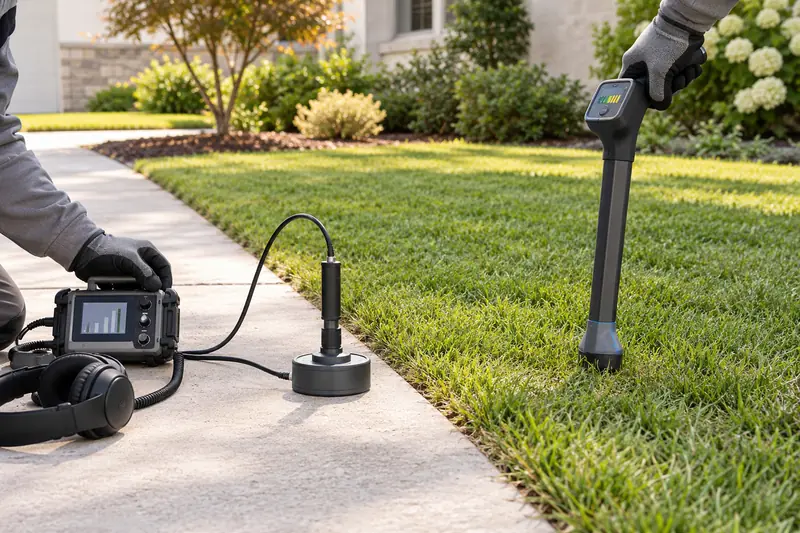
Thermal imaging displays surface temperature differences; it does not look through concrete or prove that every unusual pattern is a leak. Ask what other observation will support a suspected location. Where an opening is proposed, request the reason for its position and the uncertainty that remains before authorizing work on a finished floor or wall.
| Starting concern | Scope to discuss | Limit to clarify |
|---|---|---|
| Unexplained billed water use | Review of connected uses and private supply sections | Which branches or equipment are outside the test? |
| Wetness along a suspected buried route | Underground supply investigation | Does the route need separate confirmation before access? |
| Moisture after a fixture drains | Fixture, connection, and drain assessment | Is containment testing included or only a visual check? |
| Dampness linked to rainfall | Roof, envelope, or drainage assessment | Will a plumbing-only appointment answer the question? |
Prepare the service route without digging for proof
Gather any existing sketch, renovation record, or earlier locating report that describes the private line between the supply point and building. Mark a route as suspected when it has not been verified. Tell the provider about paving, gates, locked equipment spaces, and areas controlled by someone else. Those details help define what can reasonably be tested during the visit.
A wet patch is not permission to excavate. Ask who will arrange utility-location requirements and any additional private-line locating before ground disturbance. Confirm access permission for the actual work area, particularly where a route may cross a shared space. Do not remove paving or drive a probe into the ground to make the symptom easier to see.
Indoors, make accessible storage areas available where safe and identify the person authorized to approve further access. Explain whether water service can be interrupted and who needs notice. If an investigation involves a tenant, business, or shared installation, agree on the communication contact so an unexpected shutdown or access request is not left to someone without authority.
Preserve repair records for sewer-averaging questions
Owasso's published sewer-averaging guidance uses water consumption from December, January, and February to establish a residential sewer average. Its public guidance also asks customers who had a leak during those months to provide repair receipts. Ask Utility Billing how the current rules apply to your account; a detection appointment cannot promise an adjustment or refund.
Keep the symptom dates, affected line or component, repair date, and itemized work record together. Ask the repair provider to describe what was actually corrected rather than writing only a general service label. If testing preceded the repair, retain that report separately so the sequence of finding, access, correction, and verification remains understandable.
A changed sewer charge is a billing question, not proof of a fresh leak. Likewise, a lower water reading after a repair does not establish the utility's decision. Do not delay work needed to protect the property while waiting for paperwork. Ask billing about required evidence and submission steps, and retain copies of what you send and any decision received.
Compare cost by the investigation and written findings
The work depends on the system, available access, route information, and whether the issue can be observed under ordinary operation. Compare proposals for the same question. One may cover an accessible indoor assessment while another includes private underground testing. Ask which result each visit aims to deliver and which additional stage would need your approval.
Clarify whether findings include the tested section, conditions, observations, and remaining uncertainty. A suspected area, located pipe route, and confirmed escaping connection are different findings. Request enough detail for the next provider to understand what supports a repair decision. An inconclusive test should identify its limits rather than be described as proof that all plumbing is sound.
Separate detection from access work, pipe repair, drying, and restoration. Ask who is responsible for each and how additional work is authorized. If a proposed repair changes the pipe route, request an explanation of the alternative, not just a different total. Hydriva does not publish a fixed Owasso inspection price without the property and scope details.
Check the result and discuss your Owasso property
After an agreed repair, ask what observation verified the corrected component. Preserve the before-and-after findings and note any changes in water use, equipment settings, or occupancy. If the original symptom returns, explain whether it is the same location and operating pattern. That helps define a follow-up rather than repeating an investigation with no record of the first result.
Call Hydriva with the Owasso address, water supplier, symptoms, and available access contact. Mention a mixed-service subdivision where relevant, along with any utility report or earlier findings. Confirm the inspection scope and address-specific availability before arranging attendance. If the concern is a suspected gas leak, leave immediately and contact emergency services and the gas utility from safety instead of waiting for a routine appointment.
Owasso leak detection questions
Does an Owasso mailing address mean the city supplies my water?
Not necessarily. The city's service list includes subdivisions with mixed city and rural-district arrangements. Use the water supplier on the actual account and ask about the specific address. Sawgrass Park is listed as mixed service; a subdivision name alone does not identify every responsibility.
Can leak detection guarantee a sewer-average adjustment?
No. Utility Billing decides account-specific questions under its current guidance. Preserve repair receipts, dates, and the component description if a leak affected the averaging period. A diagnostic report supports the work history but is not a promise of a credit or a substitute for proof of repair.
Should I book slab testing for every unexplained bill?
No. First distinguish measured use from billing changes and identify known connected uses. Ask which observations support testing a concealed section. A fixture, appliance, irrigation branch, or private service line may require a different starting scope; the appointment should follow evidence rather than the most disruptive assumption.
What affects leak detection cost in Owasso?
The system, accessible test points, suspected route, operating conditions, and reporting requirements affect the work. Ask what is included and how further access or testing is approved. Keep repair and surface restoration separate unless the proposal expressly includes them, and call with property details to discuss the relevant scope.
What should I do about water near a public street or meter?
Keep clear of unsafe areas and use the city's official utility reporting information linked below. Describe where the water appears without opening or altering equipment. Ask whether a private-system inspection is needed after the utility reviews its part; the appearance alone does not establish ownership or the source.
Choose a relevant service
Explore Hydriva Leak Detection or return to locations and neighborhoods.