
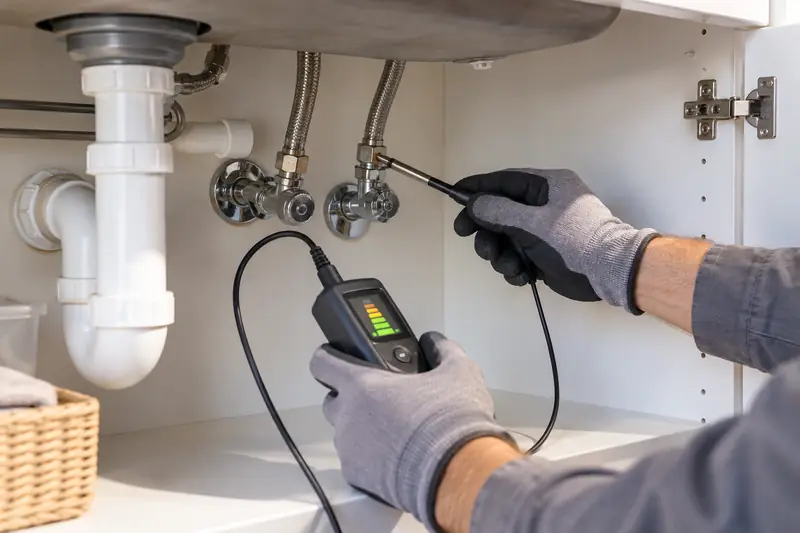
Match the investigation to the plumbing system
Supply pipes carry water to fixtures under pressure. Drains carry used water away. A stain below a bathroom can involve either system, a fixture connection, or water escaping around the bathing area. Locating the stain alone does not identify which repair is appropriate.
Describe whether moisture appears continuously, during a shower, after draining a sink, or while an appliance runs. A provider can use this history to select controlled checks. If the suspected pipe is beneath concrete or outside the building, a slab or underground assessment may be needed instead of an indoor-only visit.
Indoor symptoms and their timing
Look for a pattern you can describe without dismantling fixtures. A cabinet that becomes wet only when a sink drains provides different information from persistent moisture beside an unused supply connection. Record what was operating above, beside, and behind the affected area.
- A ceiling stain grows after a particular bathroom or laundry appliance is used.
- Cabinet bases or wall finishes remain damp near water connections.
- A toilet refills between uses, or water appears around its base after flushing.
- A concealed water sound continues when the household is otherwise quiet.
- Moisture returns after a visible connection has been repaired, suggesting another source needs assessment.
Why plumbing components can leak
Potential causes include worn seals, deteriorated fixture parts, damaged connections, or pipe defects. EPA lists corrosion and pressure irregularities among broader causes of household leaks. Finding a leaking component does not automatically establish why it failed or whether nearby components have the same condition.
For copper systems, the Copper Development Association describes water chemistry, excessive flow or turbulence, and installation factors as possible corrosion contributors. These are system-specific possibilities. Neither a pinhole nor a property's location proves a particular water-quality problem. Ask whether the proposed repair addresses a local defect or whether the evidence supports a wider piping assessment.
What an indoor diagnostic visit may involve
An independent provider may begin with exposed connections, fixture operation, and the relationship between rooms. Water can appear below or away from the area that needs investigation, so the visit should account for plumbing on adjacent floors as well as the visible stain.
Controlled checks should separate supply-side behavior from drainage or fixture use where possible. For example, the provider may compare observations when a fixture is supplied, operated, or drained. The procedure should avoid unnecessarily adding water to already damaged materials and should stop if conditions make testing unsuitable.
Where pressure testing is appropriate, the procedure must suit the installed materials and connected equipment. Uponor's guidance illustrates why material behavior and equipment isolation matter during testing. A gauge change needs interpretation within the actual setup; it is not a universal instruction to increase pressure on an existing household system.
Before authorizing a wall opening, ask which evidence points to that location and whether another accessible test could resolve the uncertainty. Agree on the size and purpose of the opening, responsibility for protection, and the point at which additional authorization is needed.
Compare indoor inspection methods
An instrument reading is useful when it answers a defined question. Methods should fit the actual access, pipe arrangement, and symptom. Ask how a proposed check distinguishes supply plumbing from drainage or fixture connections, and what further observation would be needed if the first reading does not resolve the question.
| Method | Appropriate use | What it cannot establish alone |
|---|---|---|
| Visual fixture and connection checks | Observe exposed drips or leakage during controlled use. | Condition of every concealed connection or the cause of a hidden stain. |
| Moisture measurements | Compare an affected accessible material with a suitable reference area. | The precise pipe defect or whether the moisture came from plumbing. |
| Thermal imaging | Identify surface temperature patterns for further checks. | FLIR states that thermal imaging does not see through walls. |
| Supply isolation and suitable pressure testing | Assess a defined supply section under controlled conditions. | The physical location of a concealed defect from pressure readings alone. |
| Drain camera inspection | View the accessible interior of a compatible drain. | A complete test of watertightness or an inspection of separate supply pipes. |
| Selective access | Expose a justified area when indirect evidence is insufficient. | A complete building assessment beyond the opened area. |
Prepare rooms, records, and permissions
Clear personal items from affected cabinets and provide access to the room above a ceiling stain when possible. Share appliance instructions, previous repair descriptions, and any known concealed shutoff locations. A floor plan or photograph taken during renovation can be useful even if it is incomplete.
Tell the provider about shared walls, occupied units, or equipment that cannot be shut down without notice. Arrange owner or property-manager authorization before testing or opening surfaces. Do not remove tile, disconnect an appliance, or force a stiff valve simply to prepare for the appointment.
- Record the specific fixture and activity associated with each occurrence.
- Photograph the earliest visible moisture as well as later changes.
- Identify repairs already attempted and whether the symptom changed afterward.
- Discuss planned water interruptions with anyone who depends on the connected supply.
Scope and cost factors for indoor investigations
Costs depend on the number of fixtures or branches involved, access across rooms or units, and whether the symptom occurs during the visit. Finished tile, built-in cabinets, inaccessible connections, and earlier alterations can complicate the investigation. A simple exposed drip and an intermittent ceiling leak require different scopes.
Ask whether the proposed assessment covers supply piping, drains, fixture seals, and appliance connections or only one category. Request separate terms for openings, fixture removal, replacement parts, repair, and surface restoration. Agree on how the provider will communicate an inconclusive result before additional testing or another visit proceeds.
Turn the findings into a repair decision
A useful finding identifies the affected component or test area, the conditions that produced leakage, and any remaining uncertainty. Ask whether the provider recommends repairing a fixture, replacing a connection, opening a wall, or investigating another system. A recommendation should follow the evidence gathered at your property.
After repair, request a suitable check under the conditions that previously caused the symptom. Existing staining may remain even when leakage has stopped, and drying or finish repairs may require separate work. Call Hydriva with the affected room, fixture-use pattern, and earlier repair details to discuss a focused indoor plumbing inspection.
For an intermittent fixture concern, give the provider a sequence rather than a general description such as bathroom leak. Explain which fixture was used, approximately when moisture appeared, and whether another room was in use. If several people occupy the property, ask them for observations separately so that a guessed explanation does not become the shared account of the event. Do not deliberately reproduce a damaging overflow or enter an unsafe space to complete the timeline.
If recent plumbing work preceded the symptom, keep its invoice and description available. Ask the inspecting provider to distinguish the existing installation, any recent alteration, and the actual tested connection. A useful report should identify its own findings rather than infer responsibility from the date of an earlier visit. Keep responsibility or warranty questions separate from the evidence needed to decide the next repair.
Inspection notes
When comparing the findings with a repair proposal, use the guide to reading a leak detection report to separate tested boundaries, suspected locations, and confirmed defects.
Plumbing Leak Detection questions
What changes the cost of an indoor plumbing-leak investigation?
Accessible fixture checks, concealed connections, occupied units, and intermittent symptoms create different scopes. Clarify whether the visit includes diagnostic opening, a written report, repair, or finish restoration. Call with the affected room and fixture-use pattern to discuss the inspection rather than assuming that every indoor leak needs the same work.
What address details help arrange a local plumbing inspection?
Give the city, state, full address, unit identifier, and access contact. Explain whether another floor or neighboring unit may be involved and who can authorize shared-system testing. Call with those details and the symptom timeline to confirm availability and a suitable indoor scope.
How can I tell whether a ceiling leak comes from a supply pipe or a drain?
Timing provides a clue, but it is not a diagnosis. A supply defect may leak while the connected system is pressurized, while a drain or fixture problem may appear during particular use. Water from another source can create a similar stain. Record the activities associated with the moisture and let the provider separate the possibilities through controlled checks. Do not repeatedly run a suspect fixture if doing so adds water to damaged materials.
Can a running toilet account for unexplained water use?
Yes. Water can pass from the tank into the bowl without a puddle on the floor. EPA suggests adding a few drops of food coloring to the tank and checking the bowl after 10 minutes without flushing. Color in the bowl indicates leakage; flush afterward to avoid staining. This identifies a toilet issue, but it does not exclude another leak elsewhere. Tell the provider about all symptoms rather than assuming one finding explains every concern.
Will a drain camera confirm that my plumbing is leak-free?
No. A camera provides a view inside the drain sections it can access. That view can support an investigation, but it does not examine pressurized supply lines or prove every drain connection is watertight under all operating conditions. Ask which pipe will be inspected, what could prevent full access, and what further check would be needed if the images do not explain the moisture. Request that the inspected extent be documented.
Why might the provider recommend opening a small area of a wall?
Indirect evidence may narrow the location without showing the actual connection or defect. Selective access can allow direct inspection or prepare for a repair. Before approving it, ask what supports the location, what the opening is intended to resolve, and whether the work could expand. Confirm who handles dust protection and restoration. Opening one area does not mean that the rest of the concealed plumbing has been inspected or cleared of defects.
What should happen if the leak only appears occasionally?
Provide a timeline that includes fixture use, appliance cycles, and earlier repairs. The independent provider may propose controlled testing or a period of observation suited to the suspected source. Ask what would count as confirmation and how a repeat visit would be arranged and charged. If conditions remain inconclusive, request a written explanation of the areas tested and the remaining possibilities. Avoid approving a specific repair solely because it is close to the visible stain.
Related inspection guides
Compare other leak detection services from Hydriva, or find your city and state in the location directory.
Sources and further reading
- EPA WaterSense: Fixture checks and toilet dye testing
- EPA WaterSense: Causes of household leaks
- Copper Development Association: Plumbing corrosion and design considerations
- FLIR: What thermal cameras can and cannot see
- Uponor: PEX piping systems design and installation manual
- RIDGID: Drain and sewer video inspection systems