
Establish what water loss means for your pool
A falling water level does not automatically identify a leak. Evaporation, splash-out, maintenance discharge and an automatic fill system can complicate observations. Start with a record of the level, refill activity, pool use and equipment operation. A useful investigation separates the loss pattern from assumptions about where water must be escaping.
Avoid judging your pool against a fixed daily evaporation allowance. Anderson Manufacturing's Leakalyzer manual explains that evaporation changes with environmental conditions, including wind and water temperature. A comparison made at the property is more relevant than a general claim about normal loss across all locations.
Signs to discuss with a pool provider
Frequent refilling, an autofill running more often, persistent wet ground or a change in circulation can warrant attention. Each has other possible explanations. For example, air in the pump can relate to a suction-side issue, but the equipment and operating conditions still need assessment. Record the observation without treating it as a confirmed diagnosis.
Keep people out of areas with damaged electrical equipment or unsafe pool components. Stay away from suction outlets and do not remove drain covers. Pentair's pump safety guidance warns of suction entrapment around drains and broken or missing covers. Underwater inspection and plumbing testing belong with an appropriate professional.
- The pool needs repeated top-ups under otherwise similar use and weather conditions.
- The attached spa loses level while the pool level changes differently.
- Wetness persists near the equipment pad or a suspected buried plumbing route.
- Water loss appears to change with a particular feature or circulation schedule.
Where pool water can escape
An investigation may consider shell cracks, liner damage, skimmer connections, return fittings, light-related penetrations and accessible equipment. Buried suction, return and dedicated feature lines create separate possible loss paths. A pool with a connected spa, solar system or water feature needs a scope that identifies which circuits will be included.
Do not assume that an obvious surface crack explains all water loss. A fitting problem and a plumbing leak can coexist. Likewise, the height where water appears to stop falling is a clue rather than a reliable map of the failed part. Ask what evidence will distinguish the suspected component from other connected paths.
How evaporation comparisons help
Anderson Manufacturing describes comparing a marked container of water in the pool with the pool's level over about a day. Greater loss from the pool supports investigating a leak. The test does not locate the source, and rain, refilling, splash-out or changed operation can make the comparison difficult to interpret.
Ask your pool provider whether a comparison is suitable and how to record it without interfering with normal safe operation. Do not disable equipment, alter valves or let the water fall below the equipment's operating requirements on your own. If the pool is losing water quickly, seek guidance rather than waiting for a test period to finish.
A diagnosis should narrow the system in stages
The provider can review construction details and the loss history, check accessible equipment, then decide which circuits or shell details need testing. Ask for the included lines to be named explicitly. A proposal described only as a pool inspection leaves uncertainty about whether spa plumbing, autofill, water features or concealed connections are included.
For suspected plumbing loss, isolating a circuit and testing whether it holds pressure answers a different question from locating the underground break. Anderson's pressure-testing guidance distinguishes these tasks. Listening may then help narrow the repair area, while dye or other targeted checks address accessible fittings and shell details.
Ask the provider to reconcile conflicting evidence before recommending excavation. Anderson documents a case where valves that did not seal allowed dye to move through connected plumbing and suggest an additional leak. Secondary testing changed that conclusion. The practical lesson is to check isolation and confirm a result rather than treating one observation as conclusive.
Compare pool leak detection methods
A method's value depends on the question and pool material. No provider needs every technique for every visit, but the proposed method should fit the suspected loss path. Ask how a preliminary result will be verified before a repair location is marked.
| Method | What it helps establish | What it does not establish alone |
|---|---|---|
| Evaporation comparison | Whether observed pool loss exceeds a comparison water sample. | The failed component or underground location. |
| Isolated plumbing pressure test | Whether a selected circuit holds under the test conditions. | The precise break location along that circuit. |
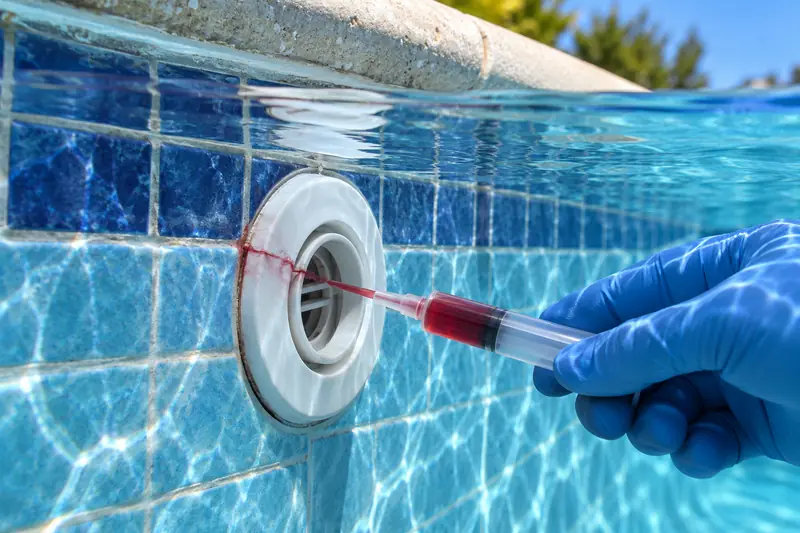
| Dye testing | Whether water moves into a suspected accessible opening. | That valves isolated all connected paths or that no other leak exists. |
| Acoustic listening | A suspected location based on leak-related sound. | A reliable result when background noise or pipe-water movement masks the source. |
| Electronic liner testing | Potential breaches in a compatible insulating liner. | A universal survey of concrete shells or buried plumbing. |
Prepare without changing the evidence
Gather pool plans, previous repair details and a list of connected features. Record autofill activity, refills, rainfall and recent backwashing if known. Share whether the pool has a vinyl liner, plastered concrete shell or another construction. Make the equipment area and safe poolside access available, with gates and barriers kept secure.
Ask the provider for water-level and equipment instructions before the visit. Do not drain the pool to reveal a suspected leak, plug lines, open pressurized equipment or disconnect pool lights yourself. Keep swimmers out during testing and arrange owner or manager authorization if the pool serves a rental or shared property.
Factors that affect the detection scope
Discuss the number of circuits, pool and spa configuration, access to fittings, water clarity and whether underwater work is proposed. Long or poorly documented plumbing runs and previous modifications may require additional investigation. Request an itemized scope covering shell checks, line testing, location marking and any written findings.
Ask what happens if a line fails its test but the location remains uncertain. Confirm whether additional listening, a second visit, limited access work or a repair is a separate charge. A useful proposal also explains how testing will account for multiple leaks and whether there is a planned check after the first repair.
Detection findings and repair decisions
A detection report can identify a failing circuit or suspected opening without resolving the repair design. A shell crack may need a separate assessment of its significance; an underground line repair may need an access plan for the deck. Ask who handles the repair, surface restoration and verification, with each responsibility stated in writing.
Electronic liner testing also has material-specific limits. Anderson's LeakTrac manual explains that ordinary conductive connections can create misleading signals and that the system does not work well in concrete pools. Confirm that any proposed electronic method matches the pool, rather than accepting electronic detection as a complete description of the service.
Prepare a short equipment and operating record for the visit. Identify automatic filling, recent cleaning or maintenance, and any changes to valves or pump schedules that you know occurred. Tell the provider if someone already added water or adjusted equipment during the observation period, because that changes the record they are interpreting. Keep a note of the conditions used for each comparison rather than combining different periods into one apparent loss rate. Ask the provider which settings should remain unchanged for follow-up, and who is authorized to make those changes. Do not disable safety equipment or operate unfamiliar pool controls merely to create a test condition.
Inspection notes
When comparing the findings with a repair proposal, use the guide to reading a leak detection report to separate tested boundaries, suspected locations, and confirmed defects.
Pool Leak Detection questions
What affects the cost of a pool-leak investigation?
Pool construction, equipment access, connected circuits, and earlier test results influence the inspection. Ask whether the scope includes line testing, shell or fitting checks, a report, and separate deck access or repair. Call with the pool type and recorded loss pattern to discuss the work needed.
How do I arrange pool-leak testing for my location?
Provide the address and state, pool type, water-level history, and pump or automatic-fill operation. Mention shared facilities and who can authorize equipment access. Call with those details to discuss pool-specific testing and confirm availability for the actual property and system.
How much pool water loss is normal?
There is no single daily number that establishes normal evaporation for every pool. Wind, water temperature, exposed surface and operating conditions affect the comparison. Record conditions and discuss a property-specific evaporation check with the provider. A generic allowance can conceal a small leak or make ordinary loss seem abnormal. Rain, refilling and heavy use also need to be recorded when interpreting a test.
Does a passing bucket comparison rule out every pool leak?
It describes the observed loss during that comparison period. It does not test each buried line or reproduce every operating condition. If the concern is intermittent, associated with a feature, or masked by refilling, share those details and ask whether additional testing is justified. Keep the original measurements rather than reducing them to a simple pass or fail label when you contact a provider.
Can the pool stay full during leak detection?
Many shell, fitting and plumbing investigations begin with water in the pool. The necessary level depends on the proposed tests and safe equipment operation, so ask for instructions specific to your pool. Do not drain it as preparation. If lowering the level is proposed later, ask why it is necessary, who will manage it and how the pool construction and site conditions affect that decision.
Does losing more water with the pump on prove a return-line leak?
A change with pump operation can guide the investigation, but it does not prove which part failed. Features, valves, shared spa circuits and equipment discharge may also affect the pattern. Ask whether the suspected line will be isolated and tested. A useful finding explains the relationship between the operating pattern and the confirming test instead of naming a repair solely from pump-on observations.
What should the findings say before anyone cuts the pool deck?
Request the identity of the failing circuit, the evidence supporting the marked location and any remaining uncertainty. Ask how the repair opening will be chosen, what happens if the break is elsewhere and who restores the deck. Also agree on a post-repair loss or line check. Call with the pool type, water-loss record, and existing test results to discuss the investigation before deck access is considered.
Related inspection guides
Compare other leak detection services from Hydriva, or find your city and state in the location directory.
Sources and further reading
- Anderson Manufacturing: Pool information gathering and bucket comparisons
- Anderson Manufacturing: Leakalyzer manual and changing evaporation conditions
- Anderson Manufacturing: Pressure testing and underground listening distinctions
- Anderson Manufacturing: Pressure testing principles
- Anderson Manufacturing: Misleading dye-test case and isolation limits
- Anderson Manufacturing: LeakTrac liner testing manual and material limits
- Pentair: Pool pump service and suction outlet safety