
By Hydriva Leak Detection. Updated .
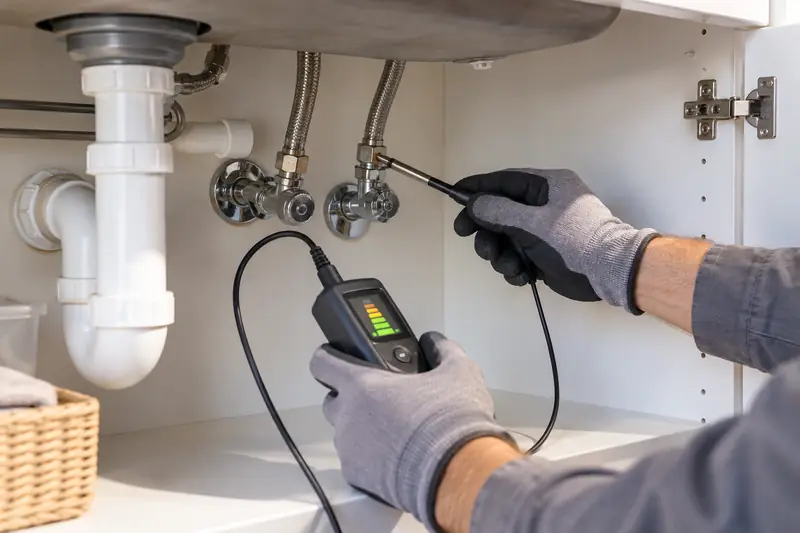
Start with the question the visit was meant to answer
Find the original symptom and agreed inspection scope before reading the conclusion. Was the appointment investigating unexplained measured water use, moisture near a fixture, a falling pool level, or a particular drain? If the question is missing, ask the attending provider to identify it. A report can be detailed and still leave your original concern unanswered.
Check the property, unit, inspection date, and access contact. Distinguish a description of what the occupant reported from something the provider personally observed. If the symptom occurred earlier but was absent during the visit, that difference should remain clear. A historical photograph may support the timeline without documenting the condition at the time of testing.
Keep separate reports together when more than one visit occurred. Identify which inspection led to access, which recorded an exposed condition, and which followed repair. A later document should not silently turn an earlier suspicion into a confirmed finding. Ask for a correction if the written sequence does not match what actually happened.
Identify the tested boundaries and operating conditions
Look for the line, branch, fixture, room, circuit, or assembly covered by the assessment. Terms such as 'main line' or 'pool plumbing' can mean different things on different properties. Ask where the tested section begins and ends, and which connected components were included. A sketch or labeled photograph can clarify the description without pretending it is a surveyed installation plan.
Ask what was operating during the visit and what was isolated, if anything. The conclusion should be understood in those conditions. If shared access was unavailable, a device was disconnected, or a system could not be safely interrupted, request that the limitation be recorded. A missing test area is not automatically a defect, but it is not an inspected area either.
Check whether a valve position was assumed or verified by the provider. You do not need to repeat the procedure yourself to ask a good question. Simply ask how the boundary was established and whether an uncertain connection changes the interpretation. Avoid treating a controller name or handwritten pipe label as proof of the current physical layout.
Separate observations, interpretations, and confirmation
An observation records something seen, measured, or heard. An interpretation explains what that observation may mean. Confirmation requires evidence supporting the specific conclusion being claimed. Read the wording for those differences rather than looking only for a bold location mark or a recommendation to open a surface.
Ask the provider what finding would challenge the proposed explanation. That is useful when several possible systems are nearby or the symptom is intermittent. A report need not eliminate every imaginable cause, but it should make clear why the next step follows from the available evidence and what remains unresolved.
| Report wording | What to ask | Avoid reading it as |
|---|---|---|
| Moisture observed at this surface | What evidence connects that surface to the proposed source? | The source must be directly behind the wet spot. |
| A tested section did not hold under the stated conditions | What was included and how was the test boundary established? | The exact defect has already been physically exposed. |
| Suspected location marked | What supports the location and what uncertainty remains? | A guarantee that no further access will be needed. |
| No leak detected in the tested area | Which areas and operating conditions were covered? | All systems throughout the property are defect-free. |
Read instrument results within the method's limits
A thermal image records surface temperature patterns. FLIR's water-leak guidance discusses using those patterns for investigation, not seeing through a wall to an exposed pipe. Ask what corroborating observation supports the interpretation and whether the reported pattern could have another explanation. A colorful image without a location and explanation gives the next provider little to use.
EPA guidance distinguishes moisture sensors from flow-monitoring devices. A moisture alert identifies wetness at the sensor; a flow record describes movement through the monitored installation. Neither should be presented as the same thing as a located pipe defect. Ask which source produced the record and which part of the property it actually monitors.
Pool testing can distinguish a suspect plumbing section from the later work of locating a defect along it. Anderson Manufacturing describes isolation and locating as different steps. If a report identifies a failing circuit, ask whether the physical location was also investigated. Do not reproduce pressure or compressed-gas procedures yourself to check the result.
Camera footage, a pipe locator mark, and a containment test also answer different questions. Ask whether a recording shows an observed condition, whether the route was separately located, and what supports a claim of leakage. An instrument name in the report is not proof that every possible line was examined with it.
Make photographs and location marks usable for the repair
Ask for enough context to recognize the area later: the room, fixture, equipment side, or fixed reference used for a mark. A close-up may show a detail while hiding which of several similar connections it represents. If the work moved between units or buildings, request labels that preserve that distinction.
Keep an original copy of the report and any included recordings. Do not rely solely on a paint mark that may be covered, a message with compressed photographs, or someone's recollection of the visit. Where a proposed opening depends on a mark, ask how it will be confirmed again if the surface or reference changes before repair.
Do not ask occupants to enter unsafe spaces just to fill a documentation gap. Tell the provider what cannot be accessed safely and request an appropriate plan. Photographs should support the finding; they should not require you to climb, remove electrical covers, handle suspect sewage, or expose concealed equipment without authorization.
Use inconclusive findings to define a narrower next step
An inconclusive result can still be useful if it records the conditions, observations, and reason confirmation was not possible. Ask what additional evidence would change the decision: an operating event, authorized access, a defined test point, or a separate assessment of another system. Request a specific next question rather than an unexplained repeat of the same appointment.
If a symptom did not occur during the visit, keep a safe observation log afterward. Record the original location, date, and relevant operation without deliberately causing more water escape. A later provider should be able to see whether the new event resembles the earlier one or represents a different concern.
A report that excludes one tested section should not be stretched into a conclusion about unrelated equipment. Ask which possibilities remain relevant to the original problem. Equally, do not assume the inspection was worthless because further work is needed; evaluate whether it reduced uncertainty and whether its limits were honestly documented.
Keep the repair proposal separate from the diagnostic finding
Find out what the proposed repair changes and why that change addresses the finding. Selective access, component replacement, rerouting, drying, and finish restoration are different tasks. Ask which are included and which need separate authorization. A diagnostic conclusion does not automatically establish the price, duration, or complete scope of the repair.
If alternatives are offered, compare the evidence supporting each and the practical effects on the property. Ask what additional information would favor one option over another. Avoid choosing only from a short service label when the alternatives involve different access, materials, or responsibility for reinstating the affected area.
For a shared installation, identify who can approve the work and who needs the report. Supply the relevant findings without sending passwords, unrelated account records, or unnecessary occupant details. Ask the utility or insurer directly about its document requirements; a private report does not guarantee a billing adjustment or claim decision.
Close the record with verification and unresolved questions
After correction, ask what verified the addressed component and whether the original diagnostic question was resolved. Keep that evidence separate from a general statement that work was completed. Note any further areas requiring observation or assessment so a later symptom is not automatically assigned to the same source.
If a report contains a factual error, request a corrected version or clear addendum while keeping the original. Explain the specific issue, such as the unit, date, test boundary, or component description. Do not rewrite a provider's conclusion yourself and circulate it as their report. When arranging follow-up help, describe the remaining question and bring the relevant record.
Apply the report to the relevant system.
For unexplained supply use, the water leak detection guide explains the investigation's starting question. Where the proposed access is through a floor, compare it with the slab inspection guidance before assuming a surface mark establishes the concealed defect.
For a pool circuit finding, use the pool leak detection guide to distinguish the relevant system. For wastewater concerns, the sewer and drain guide addresses a different inspection scope. Keep those findings separate from household supply observations.
Questions about inspection reports
Is there one required format for every leak detection report?
This guide does not establish a mandatory industry or legal format. Agree on the deliverable with the provider before the visit. For practical decisions, ask for the question investigated, tested areas, conditions, observations, conclusion, limits, and recommended next step. Separate utility or insurance document requirements need confirmation with that organization.
Does a suspected leak location mean repair can begin immediately?
Not automatically. Ask what supports the location, what uncertainty remains, and who can authorize access. The repair plan should explain the intended opening and how the suspected component will be confirmed. A location mark alone does not cover permissions, utility locating, repair, or restoration.
Can I compare two reports that recommend different repairs?
Yes, but compare their tested sections, conditions, and evidence before comparing recommendations. They may have investigated different questions or had different access. Ask what explains the disagreement and which additional observation would resolve it. Do not combine partial findings into an unsupported whole-property diagnosis.
Should the report guarantee that no other leak exists?
A finding should stay within the completed assessment. Ask what was tested and what was not accessible or outside scope. An assurance about unrelated systems is not justified by one bounded test. If a separate symptom remains, call with that history and the existing findings to discuss the next appropriate inspection.