
Confirm a pipe problem before planning floor access
A damp floor does not automatically mean a pipe beneath the slab has failed. Surface spills, nearby fixtures, outside moisture, and other building conditions can require different assessments. The first question is whether the evidence supports a plumbing leak and, if so, which connected system is involved.
Supply piping and drainage beneath a slab need different investigative approaches. A water meter can help assess metered consumption but does not locate a buried defect or evaluate drain watertightness. Describe both the floor symptoms and the water-use history so the provider can define the right scope.
Floor symptoms that deserve investigation
Document the affected area and whether it changes with water use. A localized warm patch can be a useful observation, but heating systems, sunlight, or nearby equipment may also affect floor temperature. Cracks and damaged finishes deserve assessment without assuming a plumbing or structural cause.
- A persistent warm or damp area has no clear explanation from normal room use.
- Flooring discolors, lifts, or deteriorates and moisture returns after cleanup.
- Unexplained meter activity accompanies a sound or moisture concern near the floor.
- A symptom continues after accessible fixtures have been checked or repaired.
- Earlier documentation identifies piping below the affected part of the building.
Possible causes beneath the slab
The failure mechanism depends on the pipe material, installation, and service conditions. A below-slab location is not itself a cause. Copper guidance identifies factors such as corrosion, excessive turbulence, and workmanship among possible contributors to failures. These possibilities need evidence from the actual system rather than assumptions based on the age of the home.
Ask whether the provider can distinguish a suspected leak location from a confirmed explanation of why the pipe failed. The cause may remain uncertain until access exposes the component. Repeated failures may justify a wider assessment, but a single localized symptom does not establish that every buried pipe needs replacement.
How a slab investigation can progress
The provider should review the symptom history, accessible piping, and any renovation records before selecting tests. Identify whether the home includes recirculation, radiant floor heating, additions, or previously abandoned lines. These details can affect which system is being assessed and how a floor temperature pattern is interpreted.
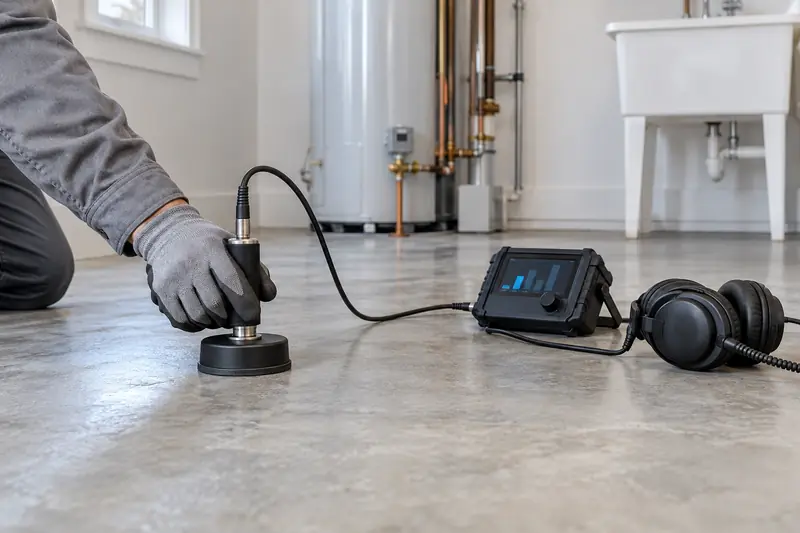
Suitable isolation checks may narrow the concern to a supply branch or another connected section. The provider may then investigate the pipe route and gather location evidence. Acoustic or thermal observations should relate to the suspected system, rather than being treated as a diagnosis merely because a reading changes near a stain.
Before cutting concrete, request an explanation of the proposed location, supporting observations, and uncertainty. Ask whether the finding identifies a specific point or a wider search area. If several signals disagree, clarify what further check is proposed and why it is preferable to immediate access.
The planned work should also distinguish plumbing detection from locating other concealed hazards and assessing the slab itself. Discuss any need for additional specialist checks before drilling or cutting. An estimate of a pipe route is not permission to proceed with destructive work.
Compare methods used around concrete
No single approach fits every slab. Compare which methods suit the installed piping, the accessible connections, and the evidence already gathered. Ask what each test is expected to add and how any suspect area will be checked before an opening through the floor is proposed.
| Method | Potential contribution | Limit to discuss |
|---|---|---|
| Supply isolation and appropriate testing | Narrow the investigation to a defined connected section. | Does not place a floor mark at the defect by itself. |
| Acoustic listening | Compare leak-related sound at accessible fittings or floor locations. | A useful signal is required; floor sound alone needs supporting context. |
| Thermal imaging | Investigate surface temperature patterns, including possible hot-water effects. | FLIR notes that contrast and depth affect concrete investigations; this is not a view through concrete. |
| Pipe route investigation | Relate other observations to a suspected pipe path. | A route does not prove where a pipe is leaking. |
| Specialist tracer gas testing | Investigate a prepared and isolated section using a detectable test gas. | Requires suitable preparation and provider expertise; it is not simply a scan of an operating water line. |
| Drain camera inspection | View accessible drain interiors where a below-slab drain is suspected. | Does not inspect separate supply piping or establish every joint is watertight. |
Prepare for a floor-focused assessment
Provide plans, prior detection reports, and photographs from remodeling if available. Mark the observed area on a room sketch instead of assuming it is the failure point. Note the floor finish, underlay, built-in furniture, and any known heating pipes or electrical systems.
Clear movable items only where practical and safe. Do not remove flooring or drill exploratory holes before discussing the diagnostic plan. Tell the provider if water has been shut off and arrange permission for access throughout the affected rooms. Any request to operate a suspect system should account for active damage.
- Record whether warmth or dampness changes after particular water uses.
- Share earlier spot repairs, reroutes, and abandoned pipe information.
- Identify surfaces or furnishings that need protection during assessment.
- Discuss water interruption needs for occupants and connected equipment.
Cost factors and the scope of a slab visit
The investigation scope depends on floor access, known pipe routes, the number of possible branches, and the strength of the available evidence. Multiple floor finishes, previous alterations, and uncertainty about the affected system can require more investigation. Detection and concrete access should be clearly identified in the proposed work.
Ask whether documentation, route marking, additional tests, or another visit are included. Discuss separate terms for flooring removal, slab opening, plumbing repair, and restoration. Compare a targeted investigation with the actual questions it will answer before treating a lower initial charge as the complete cost of resolving the problem.
Detection informs repair choices but does not choose them alone
A localized repair may be considered when the defect and access are sufficiently defined. A reroute or broader piping replacement involves different access, material, and future-maintenance considerations. Ask the repair provider to explain the evidence, assumptions, and included restoration for each feasible option.
A leak investigation is not a structural evaluation of cracks or settlement. Request the appropriate additional assessment if those concerns remain. After plumbing work, agree on verification and any remaining moisture evaluation. Call Hydriva with your floor symptoms, water-use observations, and access details to discuss the scope of a slab-leak investigation.
Before authorizing floor access, ask for a room-based sketch or another clear location reference and the evidence supporting the proposed opening. Establish whether the mark represents a search area or a confirmed escape point. Discuss the finish material, access permissions, and the process for approving a wider opening if the first access does not expose the suspected defect. Keep the locating report with the repair scope so that the opening contractor understands the original findings and their limits. This is especially important when different providers handle investigation, plumbing repair, and floor restoration.
Inspection notes
When comparing the findings with a repair proposal, use the guide to reading a leak detection report to separate tested boundaries, suspected locations, and confirmed defects.
Slab Leak Detection questions
What affects the cost of locating a suspected slab leak?
Pipe layout, accessible isolation points, floor finishes, and the evidence available influence the investigation. Ask whether locating, floor access, plumbing repair, and finish restoration are separate work. Call with the floor symptoms and water-use observations to discuss the test scope before approving an opening.
What should I provide when requesting a slab inspection in my area?
Give the full property address and state, the affected room, and any known hot- or cold-water pattern. Mention access restrictions and earlier tests or repairs. Call to confirm address-specific availability and the scope for the suspected piping, rather than booking solely on a neighborhood or foundation label.
Does a warm spot on the floor prove that a hot-water pipe is leaking?
No. A warm spot is an observation to investigate alongside water use, the pipe layout, and other heat sources. FLIR's concrete guidance explains that thermal interpretation depends on temperature contrast and conditions such as depth. Ask how the provider will connect a surface pattern to the suspected plumbing system and what other evidence is needed. A thermal image alone should not be the basis for authorizing a particular floor opening or repair.
Can a cold-water leak beneath a slab be investigated?
Yes, but a temperature-based approach may provide little useful evidence under some conditions. An independent provider may consider suitable isolation, acoustic investigation, route assessment, or another method based on the system and access. Ask what happens if the initial method is inconclusive. No method should be represented as certain to identify every cold-water leak, and an unsuccessful thermal scan does not by itself establish that the buried piping is sound.
How precise should the location be before concrete is opened?
There is no single precision promise appropriate for every property. Ask whether the provider has identified a supported point, a short section, or only a broad area. Request the observations behind the mark and an explanation of remaining uncertainty. Agree on an access plan and a stopping point if the expected pipe or defect is not encountered. A clearly explained search area is more useful than an unexplained claim of exact accuracy.
Does a slab leak mean I need to replace all the plumbing?
Not automatically. The decision depends on the confirmed defect, access, history of failures, and condition of the relevant system. Request separate explanations for a local repair, a possible reroute, and any broader replacement being proposed. Compare what each option includes, how the affected line would be verified afterward, and who handles finishes. Detection evidence can support the discussion, but it does not establish the condition of every concealed pipe in the building.
Can a slab leak inspection explain foundation cracks or damaged flooring?
It can investigate whether a plumbing leak is supported by the evidence, but it does not establish every cause of a crack or floor defect. Ask the provider to distinguish plumbing findings from structural or material questions outside the agreed scope. Separate evaluation may be needed before repair planning. Even after a pipe is repaired, moisture assessment, flooring work, and investigation of unexplained movement can remain separate responsibilities.
Related inspection guides
Compare other leak detection services from Hydriva, or find your city and state in the location directory.
Sources and further reading
- FLIR: Finding possible leaks in concrete and thermal limitations
- Sewerin: Electro-acoustic water leak detection principles
- Sewerin: Tracer gas operating instructions and preparation requirements
- Copper Development Association: Factors contributing to copper tube failures
- Uponor: Material-specific testing and installation guidance
- RIDGID: Drain inspection and locating equipment categories